

Would you rather be lucky, or rich?
Luck: success or failure apparently brought by chance rather than through one’s own actions. (AHDEL)
Luck could be either good or bad, but to be ‘lucky’ generally implies you are imbued with a magical trait of attracting good fortune. You might argue being lucky is better than being rich because if you are lucky, you likely will also be rich. But is that true? Even if you are lucky and win the big lottery, is being rich the goal of life?
Human beings tend to admire ‘success’; and very often define success as wealth, and the power and status wealth affords. But the admiration comes with a touch of envy, even resentment: their success wasn’t earned, it was luck. They had the good fortune to be born into wealth and privilege; they were lucky to inherit ‘good genes’ – strength, talent and beauty that gave them advantage in the race of life. She was in the right place at the right time when fortune smiled on her as she bought the winning lottery ticket, found the 20-dollar bill on the sidewalk, bought the Shopify stock.
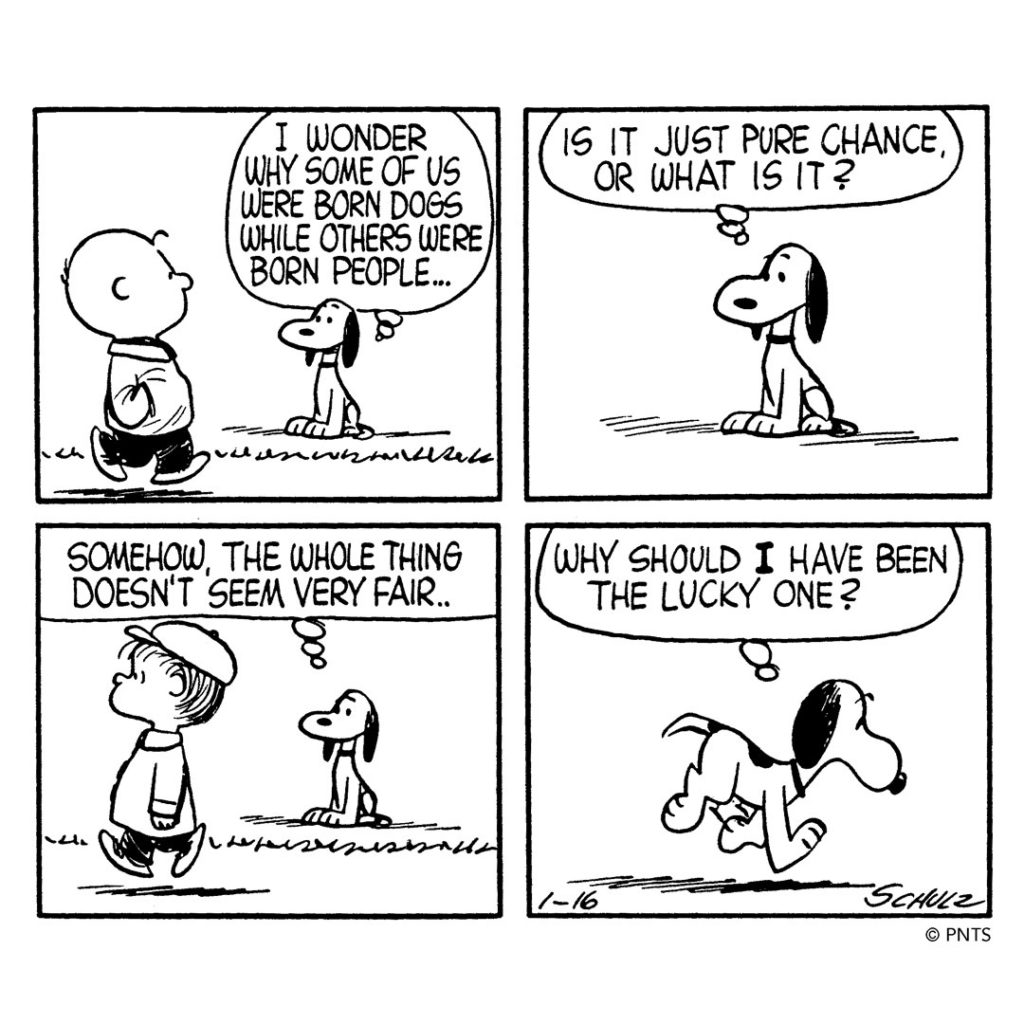
Zoologists remind us only humans have a conception of wealth. Other animals do not accumulate material goods, (well, except perhaps for crows and magpies), nor feel the curse of envy. Anthropologists do suggest, however, as with other primates and most social animals, human beings seek power, and the status that affords – probably because of the advantages power brings: priority over others, especially to eating, and breeding rights. And if you can’t be the alpha male, or alpha female, being close to the alphas brings its own referred power and status.
So, if you lack brain or brawn, or inherited wealth, better to be lucky and be shown the easy path to wealth, power and status.
Don’t get me wrong, I’m not against prosperity. I’m not of the St. Francis of Assisi school of virtue. Financial security provides relief from the sting of worry and anxiety. But is power and status really what we want out of life?
Readers of this blog have heard me preach that the point of life is not wealth and materialism, nor even status and power, but the personal satisfaction that comes from achieving worthwhile things. Happiness comes from being engaged in life, accomplishing satisfying outcomes through the use of your best talents, especially for the benefit of others. For that you don’t need to be lucky (or rich), though it may help.
Randomness nevertheless happens. Having the good fortune for things arriving out of the universe to help you along with your projects is a blessing; having the misfortune of untimely adverse events, sets you back. It’s not karma, or fate, it’s just luck.
But luck often is more than randomness – being in the right place at the right time – it’s also about preparedness. Seneca advised that luck is the convergence of opportunity with preparedness; Lord Baden Powell offered similar advice to Boys Scouts, perhaps more as contingency against ‘bad’ luck: ‘Be Prepared’. Yogi Berra might have put it less elegantly: ‘when you come to a fork in the road, take it’.
I read an interesting book some 20 years ago by the quirky psychologist, Richard Wiseman, The Luck Factor. I wrote a long blog about Wisman’s assessment of luck which you can read on my AFS Consulting Blog page (here and here). Among other things Wiseman argued that some people seem to be luckier than others. In his research he found that ‘Lucky People’ tended to have higher positive scores in three of the ‘Big Five’ Personality factors than the average, and that people who self-identified as ‘Unlucky People’ scored lower than the average in these three factors: Lucky people scored higher in Extroversion (i.e., perceive external stimulus as positive and gain energy from social interaction), Calmness (i.e., low in Neuroticism – that is, do not perceive external events as threatening), and Openness to Experience (i.e., willing to try new things); ‘Unlucky people’ tend to score lower in Extroversion, higher in Neuroticism, and lower in Openness. (There appears to be no distinction between Lucky and Unlucky people with respect to Conscientiousness and Agreeableness the other two ‘Big Five’ factors). In other words, Lucky people appear to be more willing to engage with life’s events and take more risks. This doesn’t mean Lucky people always succeed, they just succeed more often than cautious careful people. Extroverted, calm, and open people are more likely to buy a lottery ticket. Or as the Great One said, ‘You miss 100% of the shots you don’t take’. Lucky people take the shot, unlucky people pass. Was Gretzky lucky, or just an Optimist.
I mention Optimism because Martin Seligman in his book, Learned Optimism, would have agreed that Optimists likely score positively on the same three of the Big Five factors as Lucky people and conversely, Pessimists would score low. Seligman’s advice to pessimists: lighten up, take the shot.
Wiseman would probably agree with this assessment. Lucky people are positivists and are more likely to recognize when the moment is fortuitous. Lucky people, and optimists, are appreciative, they are willing to acknowledge the randomness of the external event (opportunity knocks) but also that they were somehow ready to take advantage of that opportunity.
Seligman went on from his work in clinical depression to launch the Positive Psychology movement. He wrote a now famous book, Authentic Happiness, in which he encouraged people to not be hijacked by thinking in the past, or fearing the future, but to live mostly in the present, to savour the moment when good things are happening and to practice gratitude regularly, reflecting on the good in their lives.
Lucky people, so claims Wiseman, also appear to be appreciative of their good fortune. They may not even realise that their good fortune may have had as much to do with their own preparedness (hard work, training, risk taking) as the opportunity that presented itself.
It’s one thing to believe good luck brings good outcomes, (and bad luck is responsible for bad outcomes), but what of the view that in bad situations there is also good luck? Lucky people, and optimists, are also likely to see the positive in the midst of a negative event, more likely to see the silver lining in dark clouds.
Bad things happen to lucky people too, but rather than dwell on the negative and spiral into unhappiness, they bounce back, or at least find something to be grateful for in the midst of the misery. They recognize that life is not all a bed of roses, there are also some thorns. But rather than dwell on the thorns, they find something positive in the roses. This is the resilience of lucky people, this is the finding something positive about the negative event. Lucky people, and optimists, are grateful for the silver lining and count themselves lucky.
I have a friend who lives alone and recently underwent emergency by-pass surgery for blocked arteries to her heart. Of course she was justifiably stressed and anxious about the situation (she likely scores high on the neuroticism scale at the best of times), but as she recovered in post-op and her prognosis settled into high positive, she began to accept her changed circumstances, became less fearful and began to feel optimistic about her future. She began to count herself lucky:
- She was lucky that while in her GP’s office she mentioned feeling pressure in her chest while walking. The doctor stopped examining her, asked her how she was feeling at that moment – pressure, she said. The doctor immediately gave her three crushed 81 milligram aspirin tablets and called an ambulance to be rushed to the hospital;
- She said it was lucky that she had recently lost a lot of weight and had been exercising regularly, actually strengthening her heart and body making her a better candidate for successful bypass surgery and recovery;
- She was lucky to have friends and neighbours who were willing to help her out in her time of need and recuperation
- She was grateful for being so lucky.
Maybe she should buy some lottery tickets.
Doug Jordan, reporting to you from Kanata
© Douglas Jordan & AFS Publishing. All rights reserved. No part of these blogs and newsletters may be reproduced without the express permission of the author and/or the publisher, except upon payment of a small royalty, 5¢.
